
 All Case StudiesConstructionManufacturingEquipment DealersTrade Show
The Complete Guide to Trade Show Video Production
A major industry show is the most expensive week on your calendar. Space, freight, rigging, machine transport, a dozen people out of the field for five days.
Video is the part that keeps working after the crates go home. This is how to plan it, shoot it, and use it — for equipment manufacturers, contractors, and dealers who exhibit at shows where the machines are the size of a house.
Two different jobs, two different plans
Trade show video is really two separate efforts, and confusing them is why so much of it disappoints.
The first is content for the booth: loops and demo reels that run on your monitors and pull traffic. That gets made weeks in advance.
The second is coverage of the show itself: demos, launches, interviews, testimonials, floor atmosphere. That gets made on site, under pressure, and it is where the year's content comes from.
Budget for both. They do not substitute for each other.
Booth content: built to be watched from twenty feet
A booth loop is not a commercial. Nobody is going to stand there for three minutes with a beer in one hand and a badge in the other.
What works on a show floor:
- Silent. Assume nobody will ever hear the audio.
- Ninety seconds or less, on a hard loop.
- One idea. The machine working, or the process, or the result.
- Big subject in frame, minimal text, high contrast so it reads under exhibit lighting.
- Real jobsite footage, not stock and not renderings unless the machine does not exist yet.
The loop's job is to slow somebody down long enough for one of your people to start a conversation. That is the whole measure of whether it worked.
Practical delivery notes: 1080p covers most booth monitors, 4K is worth it on large LED walls and close-viewing screens. Ship MP4 with H.264 for anything running off a USB stick or a media player, and bring a backup copy on a second drive. Test it on the actual screen during setup, not on your laptop.
The pre-show content nobody makes
Most companies start thinking about show video the week of the show. The two or three weeks before it are wasted, and that is when your customers are deciding whose booth to walk to.
Cheap, high-return pre-show pieces:
- A short teaser of what you are bringing — the machine on a truck, a crate, a covered unit
- Your product manager saying what is new, in thirty seconds, shot on the shop floor
- A booth-number card cut into every social post for two weeks
- A direct-to-camera invite your reps can send to their own accounts, not to a list
None of this requires a crew on location. It requires somebody deciding in week one instead of week five.
Logistics that decide whether the shoot works
Show floors have rules, and a crew that finds out about them at the door loses half a day.
- Badges. Every crew member needs one, and exhibitor badge allotments run out.
- Load-in and load-out windows. You cannot set lights during move-in traffic.
- Power at the booth. Confirm circuits early; show power is ordered in advance and expensive to add late.
- Somewhere lockable to leave gear overnight, or a plan to haul it back to the hotel every night.
- Internet. If you are posting same-day, the hall wifi will not do it. Plan for cellular.
- Union and venue rules on who may touch what. In some halls your crew cannot run their own cable.
Ask the show's exhibitor services for the filming policy in writing before you book anyone. It is a five-minute email that prevents a very bad Monday.
Shooting on the floor is a different discipline
Exhibit halls are loud, badly lit, mixed-color, and crowded. You cannot control the environment, so you plan around it.
What consistently causes problems:
- Ambient noise. A shotgun mic will pick up the whole hall.
- Lighting that swings from daylight LED to tungsten to whatever the neighboring booth installed.
- No room to back up. Wide lenses and tight corners.
- Demo schedules that slip, and customers who show up when they show up.
The fixes are boring and they work: wired lavaliers on every interview, a small light kit you can move in one trip, a shot list that survives the schedule falling apart, and two cameras on any demo you only get one run at.
Set up an interview corner and use it all week
The single highest-value thing you can build into a booth plan is a small controlled space for interviews — a corner with a clean background, a light, and a chair.
Once it exists, you will fill it. Product managers explaining the new model. A dealer principal on why he carries the line. Customers who stopped by and are already in a good mood. Your own engineers, who are usually the most credible people you have and almost never get used.
Line up your testimonial subjects by email before the show. People agree in advance and freeze when a camera appears in the aisle.
Give interviewees three questions ahead of time. Not a script — a script makes people sound like a spokesperson. Three questions makes them sound like themselves.
Same-day turnaround is the whole point
The industry pays attention to a show for about a week. Content that posts three weeks later is documentation. Content that posts that night is marketing.
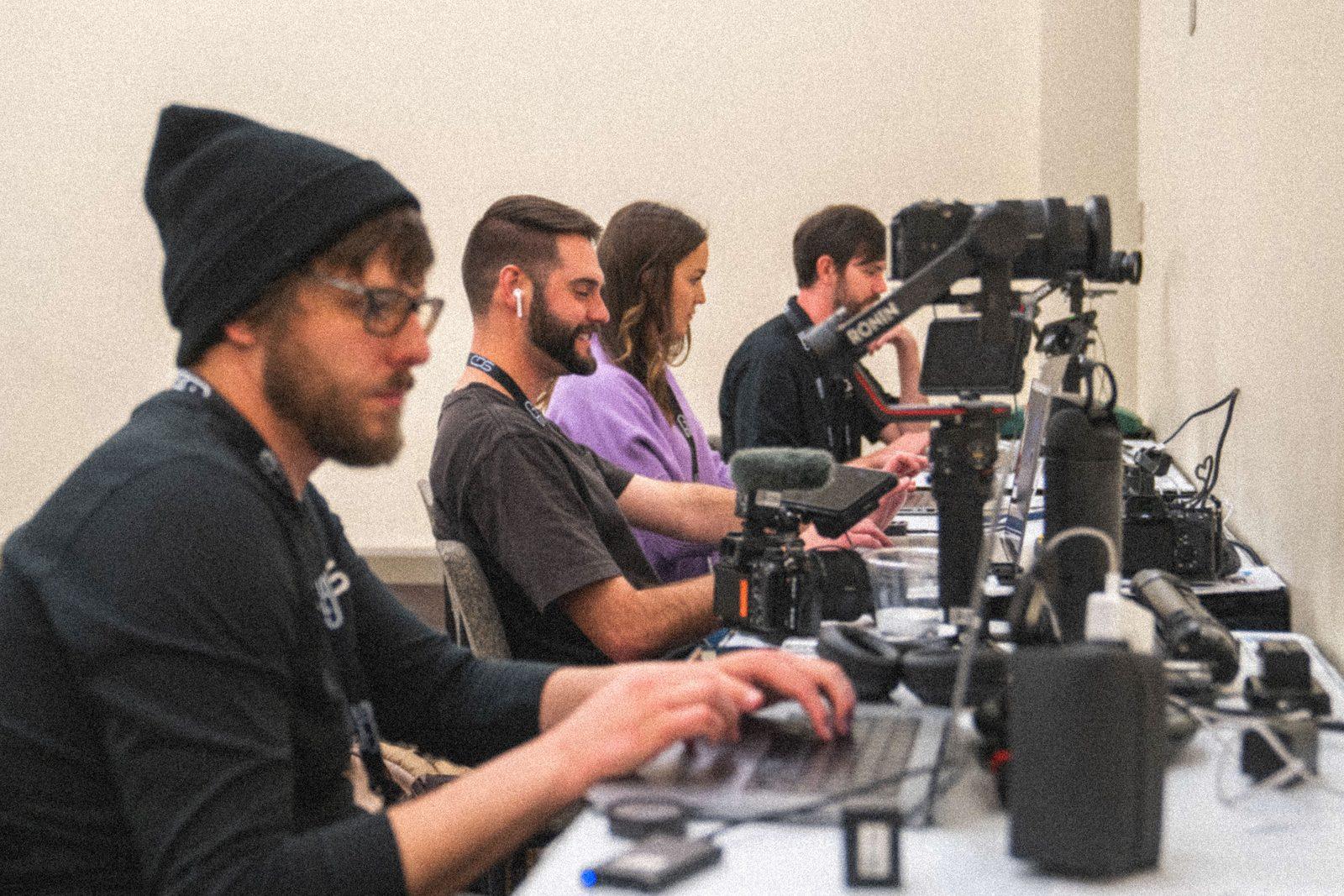
That means editing on site — someone cutting in the hotel that night while the crew shoots the next day. It also means your own marketing people are not doing it. They should be working the booth.
"Our trade show coverage has by far gotten the most views and the most impressions of anything we do." — BOMAG
Decide before you go what ships same-day: usually a hype cut from day one, a launch clip when the reveal happens, and one or two short customer moments. Everything else can wait for the real edit.
Capture the demos properly
Live demos are the most valuable footage at any equipment show, and the easiest to blow.
Cover them like this:
- Two cameras minimum — a wide that holds the whole machine and a tighter one for detail.
- Get the crowd in at least one shot. A demo with people watching sells better than a clean plate.
- Record the presenter's audio on a lav, separately from the camera.
- Shoot the setup and the teardown too. That footage cuts into how-to and service content later.
- Grab stills during the run. Your team will need them for a year.
Shoot more than your own booth
The footage that makes a recap feel like an event rather than an advertisement is the footage from outside your ten feet of carpet.
Worth grabbing, where the show allows it: the scale of the hall, crowds moving between stands, the keynote room filling up, equipment being unloaded during move-in, and the walk from the entrance. That material sets the stakes and makes your booth footage land.
Move-in and move-out are underrated. A time-lapse of your machine being rigged into place is one of the easiest strong pieces of content at any equipment show, and almost nobody shoots it.
Consent, safety, and the rules of the hall
Get permission before an attendee's face ends up in a post. Most people say yes; the ones who do not usually have a competitive reason and you want to know that.
Check the show's rules on filming outside your own booth space — many halls restrict it, and some require credentials. If you are shooting near operating equipment, the same site rules apply as anywhere else: PPE on, know where the machine can move, and stay out of the operator's blind spots.
The post-show cut is where the return is
You came home with a week of footage. Now build the assets out of it.
- A recap piece for the website and YouTube
- Short vertical cuts for social, released over the following quarter
- Each testimonial as a standalone sales asset, tagged by product and segment
- Demo segments dropped onto the relevant product pages
- Next year's booth loop, built from this year's best footage
Then measure something real. Views are the least useful number you have. Look at which clips your sales team actually forwarded, which product pages held visitors longer after the video went up, and how many closed deals had watched something first.
The short version
Plan two things: what runs in the booth, and what gets captured on the floor. Build an interview corner and keep it busy. Post same-day. Cut the rest over the next three months.
The show is five days. Handled right, the footage works for a year.
How Trade Show Video Coverage Can 10x Your ROI
Video Production Equipment: The Definitive Checklist for 2026
A hype video out by Friday — and 12x the return on one trade show.

Fort Mill, SC 29708